When you really like something, you think about it a lot. And as you think about it, you discover lots of little gripes that prevent it from being more perfect. Those issues, when discussed, might make it seem like you don’t like the thing, but actually they are a symptom of liking it so much. So just to be clear before I begin, I really like Pacific Drive.
Pacific Drive is a game with a slippery genre. It’s mainly a survival game, with a flavour of horror and elements of rogue-like and extraction looter. The narrative is a science fiction mystery that runs like a radio play. The gameplay loop sees you head out into a mysterious “Zone” in search of answers, salvation and – mainly – loot as you desperately try to keep your trusty station wagon running to the end of this journey and into the next.

The loop itself is a near-perfect execution of the standard survival formula. Drive out into the hazardous world to find resources that allow you to make better equipment so you can get more resources when you head out the next time. So when you get back you can build better equipment and blah blah blah. When done well, as here, the repetition is addictive with each new addition to your survival arsenal providing impetus to head back out and try it. Pacific Drive provides a variety of interesting and unique options to increase your range in the Zone, and also your chances of survival.
The star of the show is the car itself, which functions as a character in its own right. Some of the highlights of the game are in the nervy early stages as you try to keep the car limping on – patching tyres, siphoning dregs of fuel – until the end of the current run. I found our mutual dependence nurtured a distinct affinity for the car. I looked after it and it looked after me.
Unlike more purist survival games such as Minecraft or Rust, Pacific Drive offers a narrative to provide the motivation for continued missions into The Zone. The developer, Ironwood studios, deserve tremendous credit here for the effort that has been put into the worldbuilding. Every item has flavour text in addition to hundreds of text and audio files that create a vibrant universe with a well-defined style. To nitpick, it falls a little too close to the sci-fi-wackiness-meets-modern-bureaucracy of the SCP stories and, most notably, 2019’s Control.
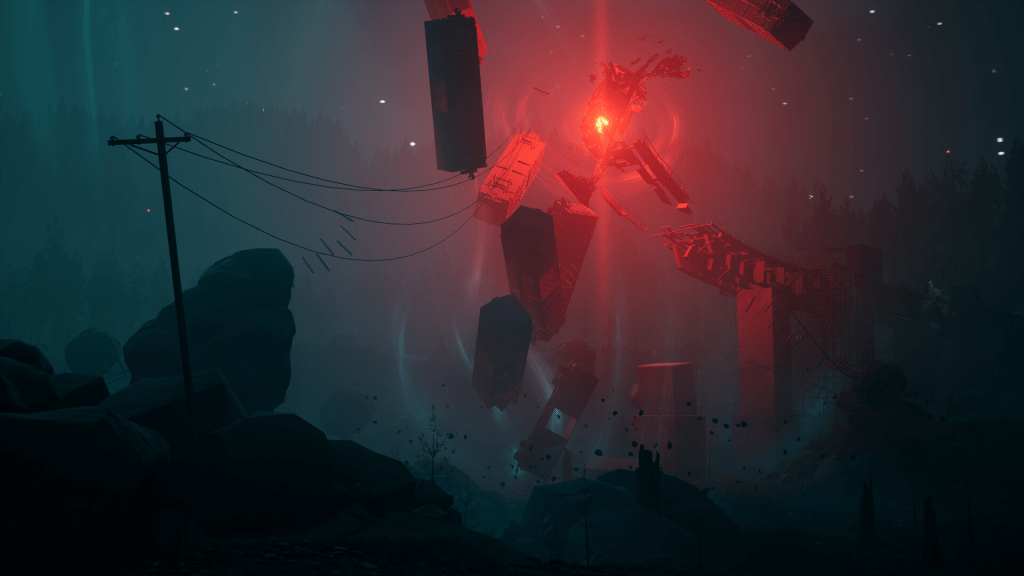
The main narrative itself is delivered as live and recorded radio transmissions. Themes include the role of science, faith, commitment, obsession and sacrifice. It is interesting enough and supplements the already enjoyable gameplay loop, but occasionally feels a bit less profound than it thinks it is. For instance, the trope of woman wanting a baby but putting career first is very much in effect here. Not exactly groundbreaking. In several key places the narrative beats don’t quite land, and in my view the silent protagonist just doesn’t work. The player has no control over the story, and even the player character has very little involvement, generally just hearing events tangentially linked to your actions play out. All of this creates a feeling of listening to a radio-play than a meaningful interactive story with at least the illusion of agency. None of this is helped by the fact the key parts of the narrative can be playing out while you desperately repair a failed engine or drive out of the jaws of danger.
Visually, Pacific Drive is stylised but fairly flawless and oozing atmosphere. The game could be compared to Outer Wilds in its semi-cartoon portrayals of nature and technology. It has a consistent aesthetic design which complements the narrative style and worldbuilding, and is regularly downright beautiful. The chaos and tension can be suddenly punctuated by moments of peace: the headlights go off and you are left with fireflies glowing over a vast alien pond; a lightning strike illuminates a rain-drenched plain.
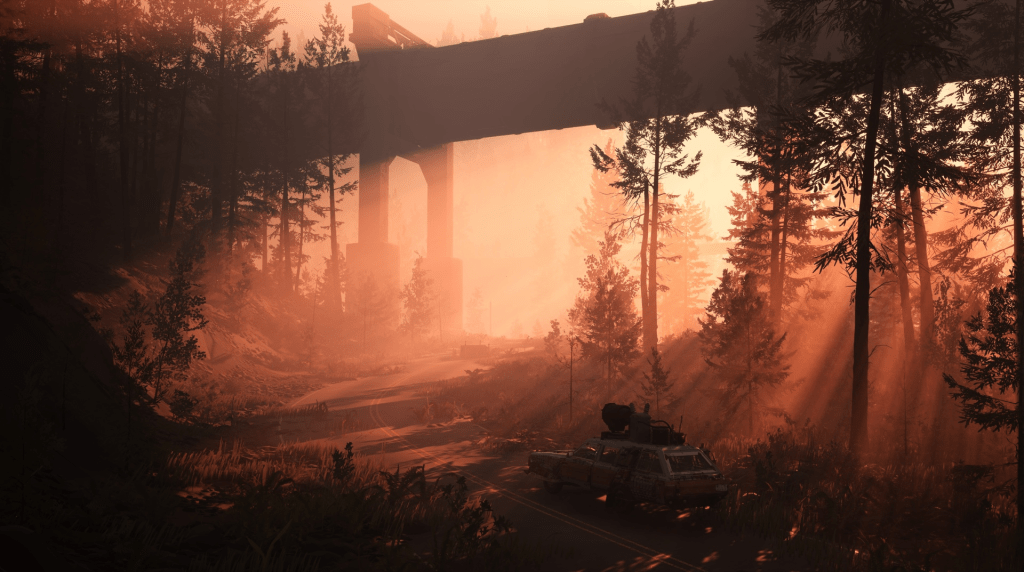
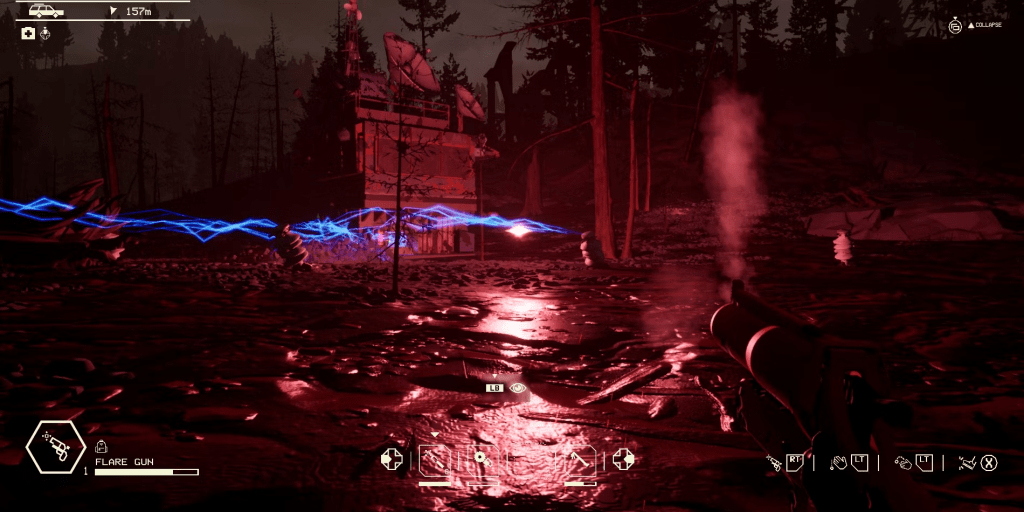
The UI fits the style of 1970’s computer technology well, but is confusing at the best of times and downright overwhelming at first. In many places Pacific Drive is about choice – should I build part X or part Y? – but sometimes the fact that those options are available is hidden across multiple menus and systems. This combines with a slightly weak tutorial that is split between voice-over vaguely pointing you in the right direction and text instruction. The result is a downright messy introduction to the systems. There were multiple upgrade paths and systems that I never knew were there or forgot. In other instances, I failed runs into the Zone because I had misunderstood how the map works, or headed into a region in search of a particular resource that was specifically not available there, but I had missed that in the small print. Perhaps a case of style over substance.
My principle criticism overall is that the game was too easy. Firstly, much of the game’s peril lies in the unknown – which is initially everything. The dark corners of The Zone are filled with creeping horrors offering unknown threats. Is this mannequin going to chase me down and eat me? Will this toxic cloud melt off my skin? And indeed, much of the first chunk of the game I spent darting out to snatch up a handful of loot before a frantic dash to the relative safety of the car. However, as you see more of these dangers on your repeated trips you learn how to deal with them, which in many cases render them barely an inconvenience. What once sent me recoiling in horror is ignored and avoided with a flick of the joystick.

The darkness is literally and figuratively illuminated because as your knowledge increases, so do your tools. These also reduce the threat from the hazards of The Zone, leading to a precipitous drop in the feeling of danger and something moving toward confidence. Even the dreaded instability that closes in at the end of each area – at first an urgent threat to be breathlessly outrun – turns out not to move that fast, and doesn’t do that much damage even when it arrives. That is not to say the car makes its return to the base (the so-called Auto Shop) in tip-top shape, and a key part of the loop is making your repairs and improvements back at The Shop. However, it was very rare to feel like the run was at risk of failure.

(If one was being generous, they could argue that making the game easier as you learn more aligns with some of the themes of science and enlightenment, but frankly that’s a bit of a stretch and feels more like imbalance.)
It should be said that I play games very conservatively, prioritising safety and resource management over speed and flair. If anything, this highlighted the fact that I could make progress in the game without taking too many risks. The only essential upgrades were the ones that allowed the car to make longer journeys, necessary in the mid- and late-game. Everything else offered convenience rather than an essential, and the player could make do without. There was nothing forcing an Anxious Andy like me to push it to the limit in hopes of some fabulous reward.
(This of course could lead to a wider discussion about whether it is possible to “play a game wrong”, and maybe I was in this instance, but that’s an article for another time)
A couple of final minor gripes. The game has some fantastic licensed music – playing out of the in-car radio – that is so well-suited and matches the rest of the excellent vibe, but needed double the number of tracks. I think every song was well-chosen, but I never wanted to hear them again by the end of my time. And then, after all of this game that relies on voice-over, sound effects and music – I reached the end of my epic journey and the credits played in silence. This genuinely felt like a bug, and if not was a missed opportunity to provide a denouement with style and atmosphere.
In the end, I really enjoyed Pacific Drive and was excited every time I booted it up. Though comparisons to Outer Wilds were overblown – it never reached the heights of discovering [REDACTED] on the Quantum Moon – its weaknesses were more than compensated by the enthralling gameplay loop and fantastically executed style.

 JH
JH 