Talk about late to the party! While writing a review of Cyberpunk 2077 in 2024 feels a bit strange, in many ways this is the best time to play the game. CD Project Red have put an enormous amount of work in since its disastrous launch three and a half years ago and have turned their own narrative into a redemption arc on the scale of No Man’s Sky. Since I didn’t play the game previously and have no reference point this review is not going to contain much in the way of comparison (that can be easily found elsewhere), but suffice it to say that as well as bug fixes, some core features have been overhauled, added or changed completely to transform Cyberpunk 2077 into a different beast (cyborg?) than on release day.
I’d like to start by describing what the game is, because despite its extensive coverage I wasn’t sure until I played it. Wikipedia states “Cyberpunk 2077 is an action role-playing game played from a first-person perspective”, which is probably a good starting point. The game follows in the vein of games like Deus Ex and draws irresistible comparisons to Bethesda’s first-person open world games. As a player you will find yourself shooting, hacking and slicing your way through a variety of mission scenarios, interspersed by story and flavour dialog spread across the richly decorated world of Night City. You’ll get experience points, level up and purchase perks.
In a sense, the above characterisation is a disappointment. The initial trailer and subsequent marketing materials promised something new, fresh and truly next-gen. What we in fact got was a very old formula, albeit executed with love, care and to a high standard.

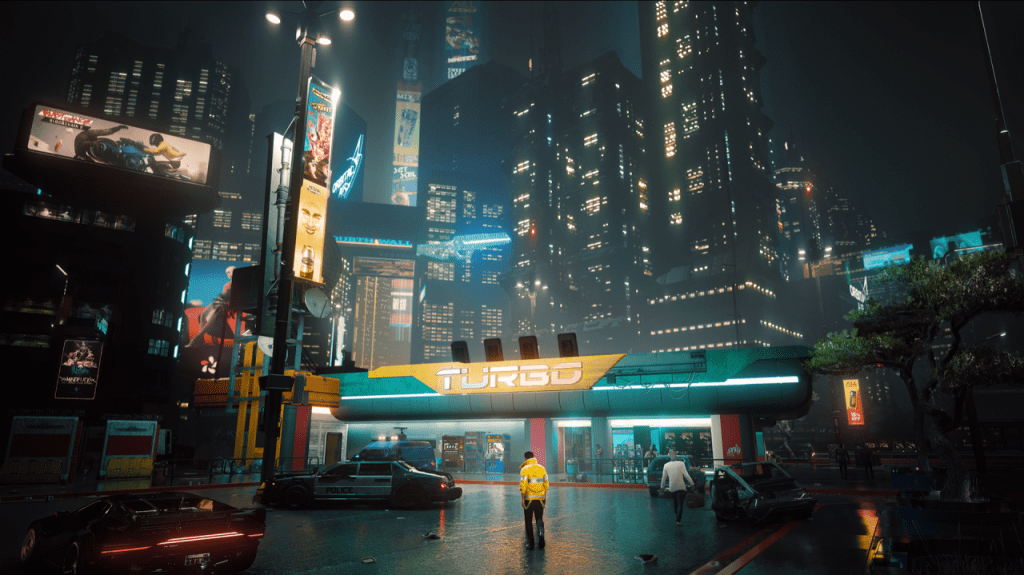
The first thing that struck me as a new player was the the world, its style and its detail. Night City is deep, layered and lovingly rendered. Though cliché, I wouldn’t hesitate to call it “alive”. Cars drive through the city intelligently, people fill the streets with purpose and meaningful conversations hum in the background. The city embodies the narrative themes by giving the impression it doesn’t give a shit about you and it exists in your absence. The first impression also states Cyberpunk‘s overall intentions: you are blasted with explicit adverts for performance enhancing drugs, cyborg implants and sex shows. This is the garish world you’re contending with.
The first act of the game features the heist-gone-wrong trope, a catalyst that drags you from seedy underbelly to sparkling heights of Night City. The story is large in scale, in terms of length, scope and themes. Continuing CD Project Red’s trend of making a blockbuster game out of esoteric media, Cyberpunk is based on a tabletop game released in 1988. This in itself inherits much from the book Neuromancer, and in many ways this feels like Neuromancer: The Videogame. It explores a world of corporate control, body modification, the nature of identity and an awful lot more besides. Cyberpunk probably bites off more than it can chew in this regard, but approaches its sprawling ideas with thoughtfulness and a sense of humour at all times. Much of the content is optional, seen through side quests, leaving the player to decide how much they want or need.

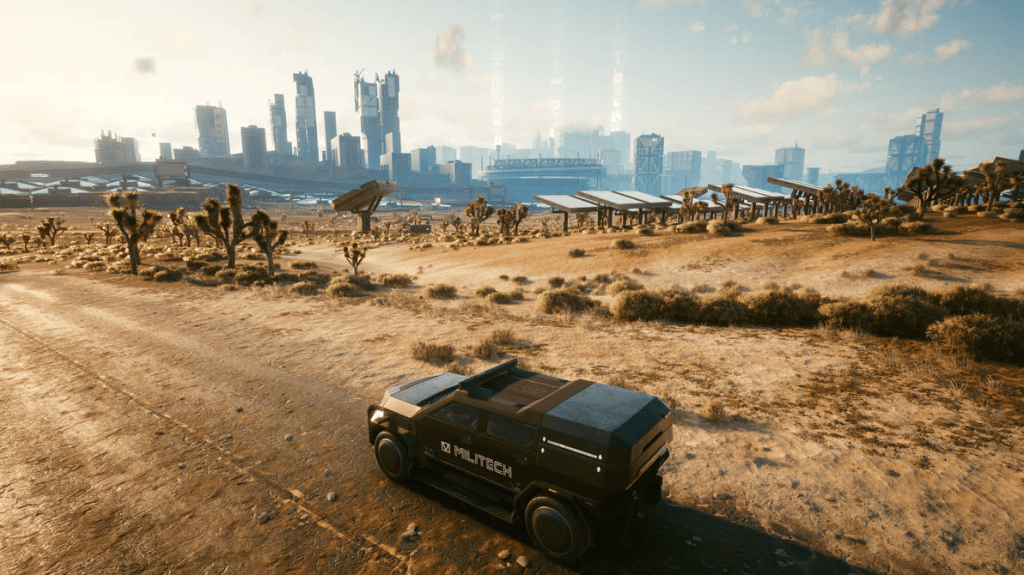
As noted, Cyberpunk works well as a cohesive whole. All of the above is reinforced and integrated with a consistent visual style. We can find the typical “neon-noir” of the cyberpunk genre in night-time city districts lit by glaring ads and store fronts. There is effective distinction between regions of the city, each with their own style and visual language: down-market sprawling residential semi-slums, upmarket LA-style mansions and sweeping industrial complexes. The map also features more rural areas surrounding Night City which provide a topographical pallet cleanser. Certainly, Night City is a pleasure to walk, fight and drive through and serves as a fantastic substrate to the game that lies on top of it. It feels like a real, working city and reminded me of large cities that I had visited myself – in much the same way The Witcher 3 felt familiar to my experiences on windswept moors and mountains. Furthermore, Night City feels like a character all on its own.
So you’re a tiny cog in a a gritty, in-your-face, degenerate near-future. What do you do? Cyberpunk places you in the role of a mercenary, providing a tried-and-tested conceit for the range of tasks you will be set: killing a target, kidnapping, rescuing, stealing. Here again, Cyberpunk is effective but not groundbreaking. You can shoot your way through, and the gunplay on offer here is excellent (far surpassing peers like Fallout), with a variety of weapons to choose from. Melee is also a valid option.

I’ve heard it said that Cyberpunk is an action game dressed in action-RPG clothing, and that is underlined by the lack of development of alternative approaches; principally stealth. This is my preferred play-style and my build reflected that. However, aside from the odd one-off quest objective or throwaway dialogue line, there is little motivation to go unseen. Likewise to complete the mission without killing anyone.
The game features a fairly robust “quickhack” system, which functions like magic would in other similar games. I also spec’d in this direction and found the system to offer satisfying synergies between the variety of quickhacks (blind an enemy, bait an enemy, misfire weapon etc), and also the more traditional shooting and slashing. Despite dedicated “covert” quickhacks, all of this felt like more of an accessory to the combat than to the stealth.
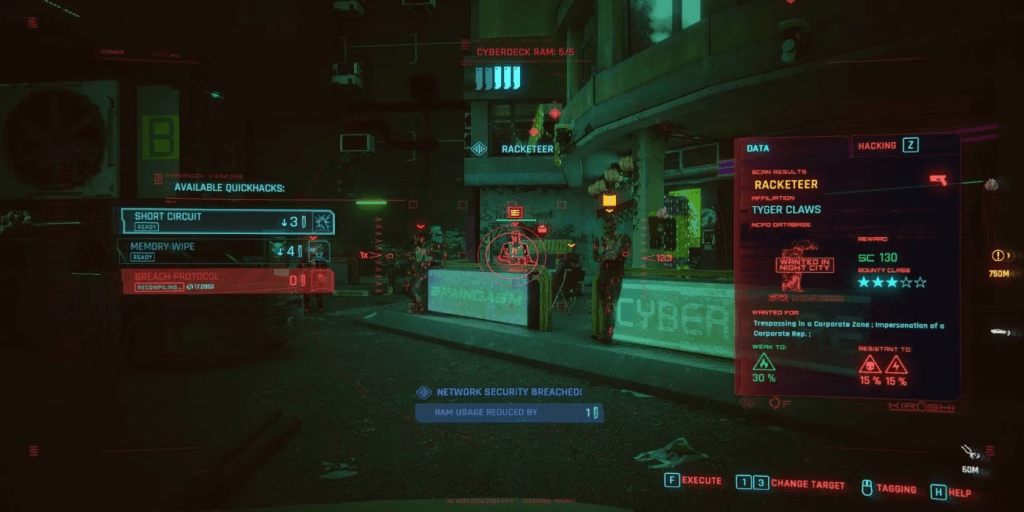
Having said that, I did have a ton of fun when I reached the top tier of quickhacks and unlocked “System Collapse”, which allows you to silently knock out (when appropriately upgraded) groups of enemies. I felt like a true netrunner bringing down a group of goons silently and unnoticed before creeping closer to my target over their spasming bodies.
A notable failure, even after upgrades and overhauls, is the inventory and crafting system. I played on PS5 but I don’t think it would have been any less painful on PC. Cyberpunk features a loot system which is again standard to peers in the genre, with players pulling “tiered” weapons off bodies and from shops which gradually get better and require swapping equipment out for new and superior options. The menu is a migraine-inducing nightmare, with weak comparison options often leaving me confused and not sure if I actually scrapped the assault rifle I should have held on to? The crafting system, which I only ever used to build “upgrade parts” to improve “iconic” weapons has a UI that seems intentionally opaque. I’m getting a headache just writing about it and I’m sincerely not convinced my loadout ended up much better than if I had just equipped every new weapon that had the green “better” arrow on it.

Conversely, praise is owed to the soundtrack: finely tuned to match the themes and style of the piece. Grimes is used both for soundtrack and as a voice actor for a pop-star character. The end credits theme to the DLC is a standout here, offering Radiohead meets Bond Theme against a futuristic twist on a Bond movie opening montage.
The soundtrack meshes nicely with my other target for compliment: the driving. Taking in Night City by car is a fantastic experience, with the radio blaring low-fi electro and the atmosphere of the neon streets oozing. Car combat was significantly improved at launch of the DLC, which was fun and thrilling but not quite a showstopper. The game features a significant set of activities centred around driving which perhaps indicates that CDPR overestimated its value. My build also provided a “blow up car” quickhack/spell which meant that I could explode all my competition in the first quarter of any race and then chill for the rest. To be fair that was pretty fun, but not exactly edge-of-seat stuff.

A final, minor mar on my enjoyment, which I face with many games, is pacing toward the end. I played this game for 90 hours, and at some point after 30, 40, 50 hours, I understood the world, the vibe and I’d seen the major areas. I was finding there was a little too much downtime between missions, even if I was targeting optional one-offs. CDPR, you’ve made a good game – now get me hacking, sneaking and shooting! Cyberpunk has a fast travel system, but only from and to specific, fixed fast travel points à la Witcher 3. A quick Google shows a PC mod exists for fast-travel from and to anywhere, and I used similar on my last playthrough of The Witcher 3 to enormously boost my enjoyment. I understand that the developers have put a lot effort into making this world – and I enjoy and respect it immensely – but please trust me to know for myself when I’m ready to speed things up.
They also execute a cheeky bait-and-switch with the frequent presence of flying cars in the story and background which are never usable by the player. A sure addition to Cyberpunk 2!
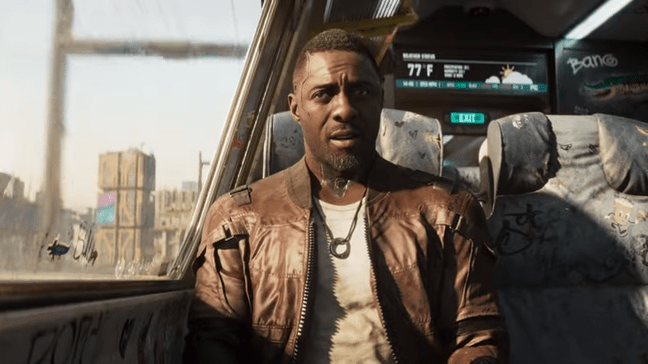
I’ve gone on long enough, but want to add a small note specifically regarding the DLC, Phantom Liberty, which I gladly purchased to lengthen my time in Night City. It adds a new region, new mission types and a new storyline to itself (and Idris Elba!). The narrative borrows from the Bourne and James Bond series, and indeed V themselves becomes a government agent not knowing who to trust. It is naturally more compact than the main narrative but I felt that this perhaps enhanced it, leaving me clearer on character motivations and the impact of my choices. Overall a fantastic addition.
To conclude, I had a blast with my 90-ish hours with Cyberpunk and its DLC. While perhaps overpromising on its initial premise, the result is a first-person action-RPG that can proudly stand shoulder-to-shoulder with it’s third-person brothers from The Witcher series. In fact, the same strengths and weaknesses are mirrored across the whole CD Project Red family. Their mechanics are respectable if not standout and their crowning glory is a world that pulses with life, feeling and grit.











 JH
JH 